
Your Roadmap to Career Growth: P.I.E. (Performance • Image • Exposure)
Written by Mariateresa Romeo
In 2010, Harvey Coleman, in his book Empowering Yourself: The Organizational Game Revealed, argued that career success in corporate America was not simply the result of hard work but of three factors: performance, image, and exposure.
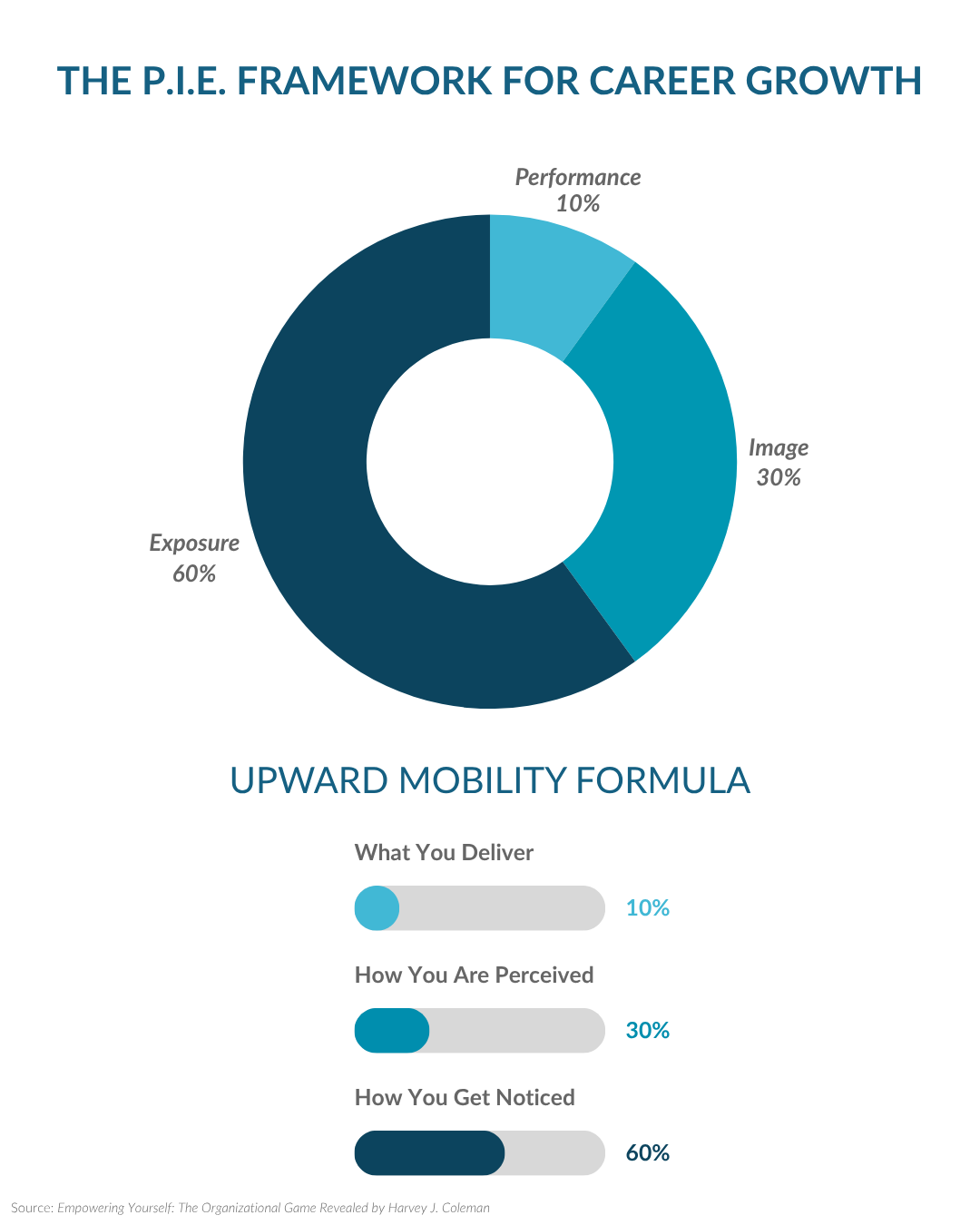
Performance accounts for only 10% of promotion decisions. Those decisions are influenced by the image we project as potential candidates and future leaders (30%), along with our ability to gain exposure to opportunities for advancement (60%).
Almost two decades after Coleman’s book, is this framework still valid? How can you use it to build a successful career in today’s corporate environment?
My answer is yes: the P.I.E. framework remains a valuable tool for moving up in your profession.
Performance, image, and exposure still determine upper-management decisions about career advancement. What may have changed is the weight of image over exposure, as social media and digital communication have increased the importance of professional image and reputation.
Without getting into the percentages in the upward mobility formula, achieving your performance objectives matters, especially in environments with structured reward programs. But to succeed, you need to focus and significantly invest your time and energy in your image and exposure.
To use Coleman’s words, professionals who succeed in climbing the corporate ladder still perform exceptionally well, cultivate the proper image, and manage their exposure so the right people know them.
What needs revisiting and adapting to today’s corporate environments is how to use the framework, and in particular the questions to assess yourself and prepare for your next career step.
Let’s dive into each of the three factors of the P.I.E. model.
Performance: Integrate AI into your Goals and Objectives
Defining your performance objectives in detail (e.g., SMART Goals), sharing them with your manager, and exploring any unwritten goals are fundamental to any performance review, as Coleman suggested.
Asking yourself the following questions is still an undeniable starting point:
What do I need to demonstrate or achieve to get to the next level?
How will success be measured?
Are my manager and I fully aligned on the goals?
Will my manager support me in achieving those goals?
Are there additional accomplishments not formally included in my goals that will be considered during my review?
However, given the extended use of AI to accomplish a variety of tasks in today’s workplace, which increases the likelihood of being considered a replaceable asset for the organization, it is essential to consider this if you want to demonstrate that you are an outstanding performer.
How can I demonstrate that I have built AI competence in my specific area?
What other goals require stronger problem-solving and strategic thinking that I could work on?
What other uniquely human skills, such as leadership, emotional intelligence, creative thinking, etc., can I demonstrate?
Image: Check for Consistency
Cultivating your image means consistently showing you belong in the corporate culture and are ready for the role you are aiming for.
In a nutshell, if you want to be a VP of Sales, act, dress, and talk like the best VP of Sales in your company. People around you must see you as a VP of Sales long before you formally get the title.
Your image includes your verbal and non-verbal communication and the reputation you build as a result.
In today’s work environment, characterized by hybrid flexibility, a myriad of tools and communication channels, and collaboration between multicultural and multigenerational teams, it is not easy to manage your image, and in particular the way you communicate who you are and who you want to be.
Your image will affect decisions about your promotion or career progression more than your performance, so you must periodically check the perception you are building with the people around you.
You can do this exercise independently or involve a trusted mentor or peer within the company by exploring the following questions:
Is my behavior aligned with the role I am aiming for?
How am I showing my willingness to be part of my team?
How am I contributing to building and nurturing my company’s culture?
What experience do people have when meeting me in person? And what about online interactions?
What professional image am I communicating on social media?
Is there any gap between my words (my values, the things I say matter to me) and my day-to-day actions?
Exposure: Facts Weigh More Than Words
Exposure means letting people know your competence, achievements, and career aspirations so you can get the support you need to reach your career goals. In a few words, it is about getting noticed.
You need to gain exposure within and outside the organization so that not only your direct manager and senior leaders but also other key stakeholders in the market and society at large support your professional journey.
The fundamental questions about building exposure remain the same:
Who are the key stakeholders within and outside the organization that can help me succeed in my career?
How can each individual or group support me? And in what capacity?
However, in an over-connected digital world where most relationships are purely transactional, it’s essential to move beyond generic visibility and engage internal and external stakeholders through experience and concrete actions that prove your value, competences, and abilities.
So you need to deepen your relationships and gain exposure through actions and experiences. Focusing on the quality of your relationships with stakeholders is fundamental:
Am I connecting with my internal or external stakeholders only to get their sponsorship and support?
How can I build a trusted relationship with them?
How can I engage stakeholders beyond social media?
Even in the digital space, how can I build credibility and back my words with facts?
Career success isn’t determined by luck or positive performance reviews alone. Like any other goal in life, achieving it requires you to clearly define what you want to accomplish, by when, and how you will get there.
The P.I.E. framework, along with the questions in this article, is a practical tool to help you develop your strategy, assuming you’ve already set a short- or long-term career goal and need a plan to reach it.
This article provides an example of the work I do with clients in my career coaching programs. I empower professionals to set career goals with confidence, develop a customized strategy, and elevate their career trajectory by utilizing a variety of frameworks and effective tools.
Related Articles
Related
GenAI and De‑skilling: Protect Critical Thinking, Creativity and Accountability
As GenAI becomes more integrated into various sectors, a key issue is the de-skilling of individuals and organizations. This happens when reliance on AI undermines the development and use of essential skills. Addressing this challenge is crucial to ensure human skills continue to thrive alongside technological advancements.
Stagnation vs. Silent Growth: Three Signs Your Team Is Thriving
The three signs that help you determine if your team is stagnating or subtly evolving during periods of stability and routine operations. Explore how to identify and address the risks of stagnation and support your team’s growth.
From Threat to Opportunity: Leading in the AI Era
As AI-driven automation transforms enterprise operations, this article demonstrates how coaching can support leaders in reevaluating their areas of control and influence, showcasing emotional intelligence and social skills to achieve quality and sustainable growth.